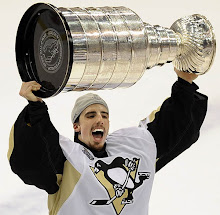
Last season, the Pittsburgh Penguins were the best comeback team in hockey.
Pittsburgh had more third period comeback victories than any other squad in the National Hockey League.
So what do they do to open up the pre-season in defense of their Stanley Cup Championship this year?
Go down 3-0 in the third period at home before rolling back to defeat the Columbus Blue Jackets in overtime, 5-4 (OT).
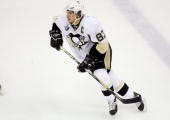
The Penguins dressed a mixed lineup typical of most exhibition games last night. Sidney Crosby, Chris Kunitz, Jordan Staal, Ruslan Fedotenko and Pascal Dupuis were among the returning forwards on the ice.
On defense, Sergei Gonchar was in the lineup, as was new free agent acquisition Jay McKee.
Marc-Andre Fleury started and played the first two periods in goal.
Despite the presence of those guys, former Penguin netminder and current Blue Jacket Matheiu Garon pitched a shut out for the first two periods before he was replaced for the start of the third by Dan LaCosta.
Not coincidentally, perhaps, things went downhill for Columbus from there.
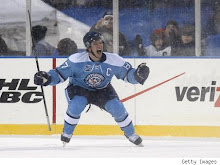
Crosby began the comeback with two goals in the first few minutes of the period, and then Chris Connor tied the game at 3 about 5 minutes in.
With about 2 minutes left in the game, Columbus took a 4-3 lead, only to have Chris Kunitz again tie the game 17 seconds later and force overtime.
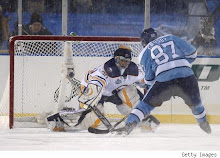
In the extra frame, Crosby intercepted a pass behind the Blue Jackets goal and quickly centered it to Kunitz, who buried it for his second goal of the game less than a minute into OT to complete the comeback victory.
True to their style, the Penguins outshot the Blue Jackets 42-28. They also played fairly physically, with both winger Eric Godard and defenseman Deryk Engelland scoring decisive first period fight victories, and Eric Tangradi -- getting his first game action in a Penguin uniform, and alongside Crosby in RW Bill Guerin's place to boot -- threw his body around all over the ice.
Tangradi didn't look entirely out of place on the top line last night, either. He finished with 2 helpers, assisting on both of Crosby's early 3rd period goals.
I still believe -- as most do -- that Tangradi will start the season in Wilkes-Barre. The Penguins are hoping he dominates at that level to the point that they won't have a choice but to make him one of their first in-season call-ups.
Another guy that held his own last night was first round draft pick Simon Despres.
Despres was paired with Gonchar and didn't look completely out of place filling that role. Expect him to get a lot of action in the pre-season, but not to make the roster. He'll likely go back to junior for one more year.
The Penguins' next exhibition game is on Friday -- again at home -- against the Toronto Maple Leafs. Then they go to the road next week to continue their exhibition slate. 3 of those games (I believe Monday, Tuesday and Saturday) will be televised on the NHL Network.
More later this week, when I'll talk in more detail about some of the newcomers and bubble players in Penguins' camp this year, including one of their training camp tryout invitees, LW Ryan Bayda, who is fast gaining the head coach as a fan.
Let's Go Pens.
Wednesday, September 16, 2009


Monday, September 14, 2009
Penguins Open 2009 Training Camp -- 5 Burning Questions
As the Pittsburgh Penguins opened their 2009 training camp on Saturday with physicals and fitness testing, and then yesterday with their first on-ice practice sessions, there's no better time than now to examine five (5) burning questions that the team faces this season as they set out to their work of becoming the franchise's 4th Stanley Cup Champion in 2010:
1) HOW WILL THE PENGUINS HANDLE BEING THE DEFENDING STANLEY CUP CHAMPIONS?
It would be hard to deny that going to -- and losing -- the Stanley Cup Final in the 2007/08 season put a strain on the Penguins at some point last year. Let's face it -- they had a short off season after playing into June in 2008, then had a short training camp as a result of beginning last season overseas with 2 games against the Ottawa Senators. Of course, the Penguins started out well for the first 5-6 weeks of the season, but quickly fell into a 8-10 week funk that many thought they might never get out of. They clearly needed to re-focus and re-energize, and under new head coach Dan Bylsma, they were able to do that --- and do it well.
This season, the challenge is greater. Not only did the Penguins play into June for the 2nd straight summer, they had 3 months of attention as the Stanley Cup Champions. Did that distract them? More importantly, how will they handle having the bulls-eye on their chest over 82 games this season? As the defending champion, they are going to get the best from their opponents every night. Bylsma will work hard in camp to establish a culture that mostly forgets about what happened last season and instead focuses on championship building from scratch all over again this year. I think that's the right approach, but only time will tell if it is successful.
2) WHO WILL PLAY SIDESADDLE FOR EVGENI MALKIN TO START THE YEAR?
This is probably the most obvious question the Penguins face going into camp.
Max Talbot, who played -- and played exceedingly well -- on Malkin's RW for most of the playoffs last year is out for the first 6-8 weeks of the regular season after recovering from offseason shoulder surgery. He brought speed, grit and an underrated scoring touch to Geno's line.
The other person on the roster at the same natural position who has just about all of those characteristics is RW Tyler Kennedy. Kennedy was an equally good fit playing with center Jordan Staal on the 3rd line almost all of last year and there might be an understandable reluctance to break up the effective unit that those two -- together with LW Matt Cooke -- formed last season. However, during the first on-ice session of camp yesterday, there was Kennedy getting the first crack at patrolling Malkin's RW.
Clearly, Blysma realizes that a more effective second line puts the Penguins at a better advantage than if they had a less-than-whole second unit at the expense of a solid, 2-way 3rd line. He also just as clearly realizes that Kennedy brings so many similar elements to the ice as Talbot did that it was worth the try in camp to see if he and Geno can develop some good chemistry.
3) WHO WILL THE PENGUINS RELY ON TO REPLACE ROB SCUDERI AND HAL GILL?
Throughout the post-season last year, the Penguins matched up defenseman Rob Scuderi and Hal Gill against each of their opponents' top forwards --- from Jeff Carter to Alexander Ovechkin to Eric Staal to Henrik Zetterberg -- and it would be hard to deny that both played the best hockey of their careers in limiting the damage incurred by all of those guys. Unfortunately, thanks to free agency and the team being close to the salary cap ceiling, the Penguins were not able to retain either one, with Gill going to the Montreal Canadiens, and Scuderi signing a multi-year deal with the Los Angeles Kings.
So who will the Penguins deploy to do what those 2 guys did?
Well, for starters, the Penguins still have several carryovers on the blueline who have proven they are pretty capable defensively. Brooks Orpik is one and Mark Eaton is another. While few guys in the league are as good positionally or with their stick as Scuderi, Eaton has always been an established shot blocker in the league, and Orpik remains one of the most physical defensemen in the NHL. Both give the Penguins a decent defensive presence.
Add to that Penguins' free agent addition Jay McKee -- another physical, defensive defenseman who is known for blocking shots -- and the Penguins are not lacking capable players who know how to concentrate on their own end. Let's hope both McKee and Eaton stay healthy, though, because both have been known to battle injuries in their careers.
I actually don't think the Penguins will miss Gill that much. His size and experience were assets -- particularly on the penalty kill -- but he had weaknesses. The truth is that playing with a guy like Scuderi helped Gill greatly. Having a partner as sound as "The Piece" on the ice with him helped cover up for the lumbering Gill getting beat wide or out of the corners by a speedy opposition forward. Gill certainly was capable, but not irreplaceable.
4) CAN BYLSMA GET THE SAME THINGS OUT OF HIS TEAM NOW THAT HIS 'HONEYMOON PERIOD' IS OVER?
What Dan Bylsma did last year with this team is one of the greatest coaching success stories in the history of the National Hockey League, in my opinion. Coming into his first head coaching gig to an underachieving team that was in real danger of missing the post-season just months removed from playing in the Stanley Cup Final, Bylsma did a fabulous job righting the ship and leading the franchise to its 3rd Stanley Cup.
But let's face it. Bylsma benefitted from the low expectations that came with his new position. And he also benefitted from the fact that his message was fresh. The Penguins' players clearly grew tired of the stale, nearly 3-year old routine from former coach Michel Therrein that they had to deal with every day. This year, Bylsma's honeymoon period is over. He will have to establish from the first day of camp that he runs the show, and will need to get his players to buy in all over again.
While the Penguins had their moments of adversity during the Stanley Cup playoffs under Bylsma, the regular season grind is a different animal. The Penguins will undoubtedly hit a rough patch or two at some point, and it will be up to Blysma to keep things from spiraling out of control like they did last season. If he can stop the bleeding when needed and avoid losing streaks of more than a few games during the dog days of the season, that will prove he continues to be capable of getting his team to respond.
Bylsma is also probably going to have to be an authoritative figure at times. Clearly, at his age, and with his experience, he's a players' coach. Only time will tell how he responds when his authority gets challenged. Tony Granato, who was brought in this year as an assistant coach and who is a bit more outspoken and assertive, is probably a good complement for Blysma in this regard.
5) WILL THE PENGUINS GET ENOUGH SCORING FROM THE WING?
There's no team in the NHL deeper down the middle than the Pittsburgh Penguins.
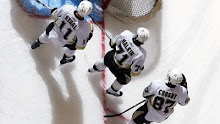
Sidney Crosby, Evgeni Malkin and Jordan Staal are a matchup nightmare for opponents night in and night out.
But carrying 3 lynchpins at center in the salary cap era comes at a cost -- wingers who are less than lethal in finishing all the opportunities #87, #71 and #11 regularly create.
Chris Kunitz, Bill Guerin, Ruslan Fedotneko and, perhaps Tyler Kennedy aren't going to be confused with the Dany Heatley's, Marion Gaborik's and Jarome Iginla's of the league, that's for sure.
Guerin is 39 and will be tested during a full season here in Pittsburgh.
Fedotenko has never been a great regular season player. He's basically a 20-goal man and, if he exceeds his ceiling, he might be able to get to 25.
Kennedy is still developing and could blossom if he sticks with Malkin all year, but that's far from certain.
Kunitz is capable of more than he showed last season when he scored only one playoff goal despite being regularly centered by maybe the best playmaker in the game for 24 contests.
Because of how well Malkin and Crosby carry the offense and score when necessary, it's not absolutely critical that the Penguins have three 40-goal scorers on the wing. But it sure would be nice for one or two of these guys to step up into the mid-30 range and become a real threat from along the wall.
Those are the questions. I'm anxious for the answers.
The Penguins already have their first exhibition game tomorrow night at home against the Columbus Blue Jackets. More on camp happenings in the next day or two.
Friday, September 11, 2009
Penguins Visit The White House
In honor of thier 2009 Stanley Cup Championship, the Pittsburgh Penguins organization was invited to The White House yesterday to be honored by President Barrack Obama.
What a cool scene.
To watch the President talk about hockey at all, let alone in an organized but relaxed tone was really interesting. I mean, when the 44th President of the United States takes the time at the beginning of the 10 minute appearance to recognize all of the legislators from Western Pennsylvania as being "in the house" to recognize the Penguins, you're on to something special.
Aside from the things one might expect -- like seeing Obama pose for pictures with the Cup, and be recognized by head coach Dan Blysma -- I'm not sure what my favorite part of the ceremony was. There were several enjoyable moments, though.
For one, Obama said having Mario Lemieux in The White House was "a pretty big deal".
Another enjoyable moment was the President turing around from the podium to recognize Evgeni Malkin as being the 3rd youngest player to win the Conn Smythe Trophy was playoff MVP, then watching Malkin pull out his cell phone to take a picture of Obama as soon as he turned back around to face the audience and have the audience break out in laughter.
When Obama turned back around, Malkin hid the phone, before pulling it out once more when Obama again turned to face the audience.
Great stuff there.
Of course, Obama was presented a black Penguins jersey with his name and the number 44 on it, in recognition of him being the 44th President of the United States.
Crosby presented him the jersey, and not long after, Obama said that he must be fast and skilled because there were a lot of big hockey players there and Crosby wasn't one of them.
That was another great moment, for sure.
And with that 10 minutes of fame, the Penguins can -- and should -- close the book on their 2009 season.
Training camp starts with players reporting tomorrow and the Penguins need to do what their brethren from the Pittsburgh Steelers plan to do.
Not repeat.
Focus on the job of starting from day one and turning the current group into one which will win a very special trohpy at the end of the year.
More in the coming days about the outset of camp and 5 burning questions which face the Penguins in their quest to again become champions.
Tuesday, September 8, 2009
5 Days Until Training Camp, '09: Penguins News and Notes
As both players and fans of the defending Stanley Cup Champions get geared up to open training camp in 2009 this Saturday, September 12, 2009, it's time to get on the pulpit more often. The olympic orientation camps are now over and soon, guys like Brooks Orpik (U.S.A.), Evgeni Malkin (Russia) and Marc-Andre Fleury (Canada), among others, will descend back home and look to bear down on a repeat in the final season it Mellona Arena.
Let's start with a run-down of various news and notes surrounding the team.
First, defenseman Philippe Boucher will not be returning to the Penguins this year, instead announcing late last week that he was retiring from the game.
There had been some thought that Boucher might return to be the Penguins' 7th defenseman this season, and the Penguins -- apparently not 100% comfortable with relying on Ben Lovejoy in that role -- did, in fact, offer him a one-year deal to return, but to no avail.
On a different note, the Penguins also remain engaged in what I think still must be described as 'preliminary' contract talks with defenseman Sergei Gonchar and Kris Letang, both of whom were key contributors to Pittsburgh's Stanley Cup Championship, and both of whom will be free agents after the coming season.
Gonchar would be an unrestricted free agent; Letang would be restricted.
I think there's a 50-50 chance -- at best -- something will get done with one of the two (likely Gonchar) before the season.
In other news, it was recently announced that the Penguins will follow the footsteps of their city brethren Pittsburgh Steelers when they visit President Barrack Obama at The White House this Thursday, September 10.
Of course, the Steelers visited Obama there several months ago in honor of their stirring Super Bowl XLIII victory over the Arizona Cardinals on February 1, 2009.
Like the Steelers, Obama invited the Penguins players, coaches, owners and staff to join him in Washington, D.C. to honor their Stanley Cup championship -- an experience that must truly be one-of-a-kind.
There's no doubt that the Penguins deserve such recognition after their outstanding season and exhilirating post-season.
On a final note, the Penguins are in the middle of their rookie camp this week.
The camp is taking place in Kitchener, Ontario, where there are daily workouts followed by rookie tournament games involving the Penguins' prospects, as well as those of the Ottawa Senators, Toronto Maple Leafs and Boston Bruins.
So far, the Penguins' prospects have gone 0-2 in the tournament, falling first to the kids from Toronto, 3-1, and then last night to the Senators' prospects, 4-1.
True to organizational form, the Penguins have had their share of shots and scoring chances. Unlike at the NHL level, however, the Pens' prospects have been unable to finish those opportunities.
On the bright side, one of the best players in the camp and tournament so far as been 2009 first round draft pick Simon Despres.
By all reports, Despres, a 6' 5" defenseman, has been strong defensively while showing an ability to start the breakout and advance the puck offensively.
His progress has to be encouraging because the Penguins seem to be getting some inconsistent play from some of their other defensive prospects --- guys like Alex Grant and Brian Strait. Of course, both Grant and Strait have time to still work on their game, and will benefit from time in Wilkes-Barre this season. Hopefully they can find the roles that suit them best. For Grant, that's offense. For Strait, that's defense.
More on the rookie camp and tournament later this week. I'll try to summarize how top prospect Eric Tangradi has performed next time.
Let's Go Pens.
Wednesday, September 2, 2009
The Debate Ends: Which Championship is the Penguins' Greatest -- The Final Installment
Over the last several weeks, I have posted 2 entries discussing the Penguins' first two Stanley Cup Championship teams and titles in an effort to set the table for a comparison between those two squads and the Penguins' latest to determine which Cup is the franchise's greatest.
Today, I will render a verdict.
Before I do that, though, a few quick reminders about just how much the Penguins of 2008/2009 accomplished. I'm not going to break down their playoff run or team this past season with the detail I did the 1990/1991 and 1991/1992 teams, because the latest playoff run that culminated on June 12, 2009 -- and the players that accomplished it -- are, I would hope, still very fresh in everyone's minds. But there are a few things that I believe deserve mentioning about the latest group to skate around in black and gold.
The first thing worth mentioning is that the Penguins were in perilous danger of not even being able to compete for the Cup just 6 weeks before the end of the season. They struggled through about 2 and 1/2 months of below-average hockey mid-season before their General Manager was so fed up with the team's performance he dismissed a coach that led the team the Cup Finals the previous season in favor of a minor league bench-boss who had just completed only his 4th month in his first full time coaching gig ever.
That alone created a storybook finish when the Penguins' won the Cup, but their rise to the post-season under new head coach Dan Bylsma wasn't the full tale by any means.
Once the Penguins got to the post-season this last year, they were focused from the start. Things didn't come easy for them but when the chips were down, they stepped up and showed a tremendous amount of character.
After all, this is the squad that won every single series on the road on its way to the Silver Chalice -- including not one, but TWO game 7's away from home in extremely hostile environments. In both of those series', they managed to win 4 of the last 5 games after dropping the first two away from home. They are the only team in the history of the National Hockey League to have done that in one playoff season.
Of course, they were the first team in 38 years to win a game 7 on the road in the Stanley Cup Finals -- and the first team in 30 seasons to do it in any professional sport -- and only the 4th team ever to do it in the NHL.
But enough about those accolates.
Let's get down to comparing the 3 playoff runs and teams to compare which title is the best one the Penguins have captured.
It's hard to say that the Penguins had the same kind of depth and star power on their most recent championship squad as their 1990/1991 and 1991/1992 teams had. Sure, they have 2 of the top 3 players in the game on their team right now, and they also have one of the better defensemen and one of the better goaltenders in hockey, but overall, the teams of 1990/1991 and 1991/1992 were, I believe, stronger up and down the roster. Certainly the 1991/1992 team was.
All that said, to say that a team with less overall talent and a bit less depth captured the Cup this last season when there was so much more overall league parity speaks to how satisfying the franchise's lastest Cup win truly was when compared to the challenge at hand. Add to that the fact that this last year's outfit was one of the few teams in the last decade to win even a single playoff round after bowing out in the Cup Finals the year before, and then to go back up against the same era juggernaut that sent them home for the season last year by winning the Cup on their own ice, and the Penguins' 2008/2009 accomplishments shine in even greater light.
But don't overlook the difficult odds the 1991/1992 championship team had to face. They were forced to avoid elimination in 3 straight games just to win the opening round, then lost two of their best forwards almost right off the hopper in round 2 against the best team in the league that year. Those hurdles were almost so overwhelming that once the Penguins overcame them, they didn't lose again in their next 11 playoff games on their way to the Cup.
Clearly, the Penguins' 2nd championship team was the most dominating.
And that's where I think we can begin to narrow this debate.
The Penguins' first Cup-winning team doesn't compare to the 2nd one or the most recent one, either in terms of adversity or quality of opposition. Pittsburgh's opponent in the final that year had a whopping 68 regular season points. The Minnesota North Stars played well when it mattered most in the post-season and were no pushover for the Penguins in the Final, but the fact is that the Boys of Winter in 1991/1992 and this past year faced -- and overcame -- bigger challenges on their way to their titles.
So, while the franchise's first Stanley Cup Championship will always hold a special place in Penguins' lore because it was just that -- the first -- it undoubtedly cannot be considered the Penguins' best.
That leaves us to this last year's Cup-winning group or the 1991/1992 team.
It's not an easy call.
So what's it going to be?
Contrary to how I feel most Penguin fans would weigh in, I believe that the Penguins' 2nd Stanley Cup in '91/'92 is the franchise's greatest.
While this past year's team did more with less, the 1991/1992 team overcame an injury to the league's best player for nearly an entire series to beat the best team in the league in that series and do it fairly convincingly. After that, they were plain dominating the rest of the way, knocking off a team in the Final, the Chicago Blackhawks, that had come into the championship round having steamrolled their way to 11 straight victories of thier own.
The Penguins' championship team from this past year wasn't even close to being that dominating for that long.
And, as I mentioned earlier, the 1991/1992 team faced elimination 3 times. While this last year's team also did that, they didn't do it all in one round. I don't know that it makes it a better accomplishment because sometimes it can be easier to get on a roll against one opponent than have to fight off elimination repeatedly against different teams, but it was something the Penguins' title group of 2008/2009 did not do.
Of course, they didn't have to do that, and that says something, so again ... it's probably a wash on that factor.
But what really tips the scales for me in this debate is my belief that the Penguins wouldn't have won either the Washington or Detroit series' this past season if Crosby or Malkin had been lost for almost all of that series, like Lemieux was against the Rangers in 1991/1992. They might have been able to change things up enough to beat the Capitals because Malkin still might have been able to match Ovechkin goal-for-goal in that series if he had to, and Washington's support players weren't giving them very much otherwise. Their goaltender kept them alive in that series in game 1 to 6 until the Penguins broke through him big time when it mattered most.
However, if the Detroit Red Wings only had to deal with one of #87 and #71 in the Finals, I'm convinced that our offense would not have been able to overcome that. Look at what Zetterberg did to Crosby in that series. That's not to say Sidney played poorly. In fact, he played so well that Zetterberg wasn't nearly able to do what he could have otherwise accomplished offensively because he was so pre-occupied with Sid all series. If Malkin was all Zetterberg had to contend with, the Red Wings' depth would have proven far superior to the rest of Pittsburgh's roster during the remainder of the series.
I think that primarly makes the difference because, as I have already mentioned, I think while the 1991/1992 team had a stronger roster, that can be turned around to say that this last year's Cup team won with less, making those things almost come out even.
Sure, the 1991/1992 team didn't have to win the Cup Finals in game 7 on the road. But that's because they were so overwhelming in the championship round, thier opposition couldn't even get to game 5, let alone a game 7.
So, to me, that's it.
The 1991/1992 Pittsburgh Penguins' Stanley Cup Championship Team is the franchise's greatest.
You tell me what you think. Speak out if you feel differently. Vote in the poll on the right. Otherwise show your colors.
Regardless, it's been great to reminisce over all 3 of the Penguins' championships.
This last year remains vivid and thrilling in my mind and, there's no doubt as far as I'm concerned, the Penguin's 2008/2009 Cup run gave the 1991/1992 title team outstanding competition to determine which was the franchise's greatest championship.
But in the end, the 1991/1992 team stands just a hair taller.
Next week, I'll talk about the Penguins' rookie camp in Kitchener, Ontario, Canada.
Just a few weeks before the opening of the team's full training camp.
Let's Go Pens.
Thursday, August 20, 2009
The Debate Continues: Which Championship Is The Penguins' Greatest -- Installment II
Well, boys and girls, it's time to continue the debate on which Stanley Cup is the Penguins' greatest.
Last week, I wrote about the franchise's first championship, and the 1990/1991 team that brought it to Pittsburgh.
This week, it's time to break down that team's successor -- the 1991/1992 entry that won the 2nd of back-to-back titles.
That Penguins' team had mostly the same starring cast for a majority of the year. Lemieux. Francis. Stevens. Jagr. Mullen. Recchi. Coffey. Murphy. Barrasso. The difference came at the trading deadline when Jagr's continued improvement in year 2 of his career permitted then-GM Craig Patrick to change the makeup of his team significantly for a 2nd season in a row.
This time, Recchi went packing to the Flyers, Coffey went packing to the Kings, and in came rugged scorer Rick Tocchet, defensive stalwart Kjell Samuelsson and backup netminder Ken Wregget.
Tocchet immediately joined Lemieux's line and, with Kevin Stevens, helped form perhaps the NHL's most fearless line down the stretch, into the postseason and even into the following year.
Despite their offense, the Penguins actually took a step back in '91/'92, finishing 3rd in the division. Lemieux's absence for 16 games was a part of that, and the team struggled a bit to get adjusted after The Badger passed away in November of that season. Nevertheless, their 3rd place finish landed them a first round playoff matchup with the arch-rival Washington Capitals.
In what was only a prelude of matchups between these teams for years to come, the Penguins lost the first 2 games on the road and ultimatley went down 3-1 in the series. Facing elimination in game 5 and struggling to get in a groove, Lemieux and others went to then-interim coach and former Director of Scouting legend Scotty Bowman and proposed that the team implement a 1-4 delay forecheck to confuse the Capitals, stifle them offensively and perhaps create some turnovers and take advantage of them.
Their plan worked to a charm. The Capitals' were stunned and had no answer for the Penguins' new style of play. Pittsburgh rolled over Washington in the next 3 games -- including games 5 and 7 on the road -- to come back from the 3-1 deficit and take the series.
More adversity awaited for the Penguins in Round 2, where they met another one of their arch-rivals, the New York Rangers, that year's President's Trophy winner as the league's best team.
As if any series of consecutive games against the blueshirts wouldn't have been intense, the series temperature went up about 100 degrees in game 2 when forever-Penguin villian Adam Graves slashed Lemieux on the hand and broke his wrist.
That injury shelved #66 for the rest of that series and, after losing game 3 in OT, the Penguins were in a 2-1 series hole.
In game 4 at the then Civic Arena, without Lemieux and also without Mullen -- who, like #66, was injured in game 2 -- Pittsburgh faced a precarious set of circumstances. They were down 4-2 in the 3rd period and had to kill a 5-minute major penalty.
Make no mistake -- the Penguins were staring hard at going down 3 to 1 in a series for the second time in a row.
At that moment, the Penguins' entire post-season --- their entire year, essentially -- turned around thanks to one man.
Ron Francis.
Francis had already scored earlier in the game. He helped the Penguins completely shut down New York's power play, then just seconds after the power play ended, scored the goal that changed everything --- a 65 foot slapshot from outside the blueline that handcuffed and somehow eluded Rangers' netminder Mike Richter, bringing the Penguins to within a goal with about 9 minutes to go in the game.
About one minute later, Troy Loney scored to tie the game.
Then, about 90 seconds into overtime, with Pittsburgh on a power play, icon Mark Messier tried to skate out of from behind his net with the puck, only to be stripped by Murphy. Murphy spun around and put a quick shot on goal which was deflected in behind the stunned Richter replacement -- John Vanbiesbrouck -- for the hat trick by Francis, finishing off one of the most memorable games in franchise history.
Highlights of that game can be enjoyed here:
http://www.youtube.com/watch?v=RkBetCrJTZw
I'll never forget that contest, because I was there in person to see it. Sure, I was up in the rafters sitting in obstructed view seating, but I can tell you that even though I was nearly farther from the ice than anyone in the buliding, I sure celebrated after the win like the players on it.
With such a big momentum swing, the Penguins went on to eliminate the Rangers by winning the next 2 games -- a close one in New York and a blowout back in Pittsburgh in game 6 -- setting themselves up for a conference final series against the Boston Bruins for the 2nd straight season.
Unlike in the 1990/1991 year, however, the Bruins were no match for Pittsburgh this time. Even without Lemieux for most of the series, the Penguins' capitalized on all the mojo their series' win over the Rangers gave them and romped over Boston in a 4-game sweep to send them to the Stanley Cup Finals for the 2nd straight season.
In 1991/1992, they matched up against a team from the then-Norris Division, although this time it wasn't the Minnesota North Stars. It was the Chicago Blackhawks -- a team that had won a then-NHL record 11 straight playoff games coming into the finals. They hadn't lost in more than a month, dating back to early in round 1 and came riding high on the heels of Jeremy Roenick, Chris Chelios and Ed Belfour.
With the Penguins' having won 7 straight of their own, that series shaped up as a clash of the titans.
Or so everyone thought.
Game 1 set the tone for that series and, for the first half of the game, the Penguins actually did themselves worse than they did in game 4 against New York at the Civic Arena.
This time they were down 3 goals, not 2, looking at a 4-1 deficit. Not to be deterred, however, the Penguins stormed back in the latter part of the 2nd period, ignited by Jaromir Jagr, who scored a goal by singlehandedly stickhandling around 3 blackhawk players to the slot from the near boards -- including one of the better defensive players in the league at the time, Brent Sutter, who Jagr left on the parkway headed to the airport -- before backhanding a shot past Belfour.
Ah, the memories:
http://www.youtube.com/watch?v=_6u1f1F5xAU
While that goal by Jagr helped the Penguins get back in the game and was one of the best goals ever scored at the old Igloo, he was topped by perhaps the only player in the game with a greater flair for the dramatic.
Mario Lemieux.
After Tocchet rallied the Penguins to a 4-4 tie with a goal with 5 minutes to play in the 3rd, it looked like overtime was looming. Even a power play the Penguins were awarded with about 11 seconds left in the game wouldn't have seemed to give them a chance to win until the extra frame.
So much for that theory. As almost every Penguin fan knows, words don't do justice to describe what happened next. Just watch:
http://www.youtube.com/watch?v=P9STr-jICqQ
In my 26 years of following hockey, I don't know that I've ever seen the Igloo get that loud. I honestly thought the roof was going to blow off. Simply incredible.
The best part is that Lemieux's goal there came off a set play that worked -- but barely. It was premised off a clean faceoff win and a shot on goal by Murphy. In that situation, Lemieux was going to go to the net and look for a rebound. But Francis didn't win the draw cleanly. And in the second or two it took for him to get the puck back to #55, Lemieux hesitated going to the net. Even Murphy hesitated as Francis tried to get the puck back to him. But #10 did, Murphy pinched a stride or two -- just enough to get a low shot off designed for a rebound -- and Lemieux went for gold at just the right moment.
If there's a play that should be freeze framed, that was it. I can only wonder what Belfour was thinking as he realized he kicked the puck right out to Lemieux's blade with only seconds to play and a gaping hole in the net to his right.
How about, "Oh F----"????
Ha.
You know, if Francis and Murhpy lose that puck, a Blackhawks' player -- I think it was Steve Larmer -- would have gone the other way on a clean breakaway. Let's face it. Lemieux was cheating a little looking for the chance to end it and, while Larmer blew it because he, too, shouldn't have been cheating and instead should have stuck with #66, the fact is that the play could have disasterously gone against Pittsburgh the other way.
Again, another momentum stealer for Pittsburgh. Of course, we all know they swept through the rest of the Final after that, including a 6-5 win and a 1-0 win, on the way to their own 11 straight playoff victories and 2nd straight Stanley Cup, culminated by Mike Lange's greatest call of all time:
"Oh Lord Stanley, Lord Stanley .... Get Me The Brandy"
Little did I know that game 4 of the Rangers series -- that one I attended -- would be the Penguins' first of 11 straight. To think they didn't lose another game the rest of the postseason. It still amazes me.
The Penguins' had quite a run that year. They again faced adversity -- although more in the form of individual game deficits (4-2 against NY in game 4; 4-1 against Chicago in game 1) and injuries (Lemieux, Mullen) than series adversity.
But the Penguins' 2nd championship has to be defined for its overall dominance more than anything else. Those 11 consecutive playoff wins still stands as an NHL record and no other team has done that since. Moreover, I don't expect any other team to do that again anytime soon. That's like just about sweeping 3 rounds in a row. With the parity that exists in today's game, you just aren't going to see that.
In considering which title is better, you can't argue with the demonstrated dominance that defined the Penguins' 2nd championship team.
Like the first Cup run the year prior, the 1991/1992 team also faced a 7-game series (and not one but two short ones, as already mentioned). And while scoring in bunches was again their trademark, they had the same degree of character and grit they had the prior year. In both seasons, the Penguins put out a well-balanced club.
In my final installment -- I'll weave in this past year's Stanley Cup championship into the equation. I won't break it down like I did the first two because the title from this past season is fresh in everyone's mind. Instead, I'll make comparisons between all 3 and, in the end, offer my opinion on which of the three is the franchise's greatest.
Until then ....
Wednesday, August 12, 2009
Let The Debate Begin: Which Championship Is The Penguins' Greatest? Installment I
As promised, it's time to begin the debate on which of the Pittsburgh Penguins' three Stanley Cup Championships is the greatest.
Some will view all 3 titles as equally great. Others will not. Certainly, each run was different for the Penguins, with different players, different moments, and different degrees of difficulty. And that's what makes this analysis admittedly subjective. Each person is going to examine the question in a way another person will not.
Personally, I believe one title stands above the others, and once I have reviewed all 3 Cup runs separately -- which I will do over the next several weeks -- I'll reveal which championship I believe is the Penguins' best and indicate why.
In the meantime, I have posted a poll to the right which gives you a chance to vote on which title you think was the greatest. I'll leave the poll posted for a while, so please weigh in and let me know what you think. Do it now, or wait until I have posted on all 3 championships and then decide.
So, without further adieu, let's review the Pittsburgh Penguins' 1990/1991 Stanley Cup Championship run and team:
The 1990/1991 season was the first and only full season Bob Johnson coached the Penguins before being diagnosed with -- and succuming to -- brain cancer early the following season.
While losing Johnson was a tragic blow for the franchise, all it took "The Badger" was a single year to leave an indelible impact on the Pittsburgh Penguins for decades to come, as evidenced by the franchise's first Stanley Cup Championship at the end of that season, and by the fact that, even today, the Penguins' rely on Johnson's famous "It's a Great Day For Hockey" phrase in promotions with the current group of flightless birds.
The Penguins were generally regarded as on the rise throughout hockey circles beginning in the late 1980's when Mario Lemieux led them back to the post-season for the first time since he was drafted in 1984. That was in the 1988/89 season and, while the Penguins missed the post-season the following year, they bounced back in the '90/'91 season after the trade deadline splash that landed them my favorite player of all time -- Ron Francis -- and Ulf Samuelsson and returned the post-season on the heels of the team's first Patrick Division championship.
In round 1, the Penguins faced off against a Patrick nemesis, the New Jersey Devils, and they didn't have an easy time of it. After battling the Devils even in the first four games, the Penguins lost game 5 at home and faced elimination on the road in game 6. Worse, starting star goaltender Tom Barrasso came up with back spasms at that point in the series and had to give the crease over to backup netminder Frank Pietrangelo.
What did Pietrangelo do? Only make one of the greatest stops in NHL history in game 6, robbing New Jersey star Petr Stastny with a reachback glove effort that is known in Pittsburgh only as "The Save". For those who can't ever get enough of watching that save, click here:
http://www.youtube.com/watch?v=wAh5PTg_Qr4
That save virtually took the steam right out of New Jersey. The Penguins won that game 4-3, then returned home and finished off the Devils with a 4-0 shutout -- again with Pietrangelo in goal -- to send New Jersey packing and set up a 2nd round set against the Washington Capitals.
Unlike many of the Penguins' series against the Caps' in ensuing years, this one was not a 7-gamer, nor one where the Penguins had to come back from a 2-0 or 3-1 series deficit. After dropping the first game of the Patrick finals to Washington that year, the Penguins won in overtime in game 2 when Kevin Stevens finished off a 2-on-1 by taking a Francis pass and beating Caps' netminder Mike Liut. Again, highlights anyone?? :
http://www.youtube.com/watch?v=Bgcsy9zyeYE
Watching that clip was a great reminder of how Caps' defenseman Al Iafrate was no Paul Coffey. Iafrate basically tried to mimick what Pens' D-man Coffey did just seconds before and rush the puck all the way up the ice. Fortunately for Pittsburgh, Iafrate turned over the puck and that led to the 2-on-1 that Stevens finished.
Washington never recovered after that. They dropped the next 2 games at home and the Penguins finished them off in game 5 back at Mellon to set up a Conference Final against the Boston Bruins.
It's hard to forget the Bruins' series, because the Penguins dropped the first two games on the road -- including game 2 on an overtime goal by Bruins' forward Vladimir Ruczicka -- and were staring hard at a quick elimination at Boston's hands.
In the locker room after game 2, Stevens boldly and unambiguously declared that the Penguins would come back and win the series. Stevens' Penguin teammates obviously rallied around that cry because they then won the next 4 games and rolled the Bruins right out of the postseason in dominating fashion in the process, outscoring Boston in those games 20-7.
The Penguins' series win against the Bruins' propelled them to their first Stanley Cup Final, against the Campbell Conference Champion Minnesota North Stars.
While I don't think many NHL observers at the time necessarily expected a Pittsburgh/Minnesota final, the teams played a fairly good series -- especially for the first 4 games. And it's hard to say what was more notable about the series looking back.
Obviously, the Penguins' first Stanley Cup championship stands out high on the list of franchise moments, but there probably isn't a hockey fan alive that hasn't seen or doesn't know about Mario Lemieux's heart-stopping goal in game 2, where he went 1-on-2 on a rush into the Minnesota zone, split North Stars' defenseman Mark Tinordi and Shawn Chambers -- leaving Chambers in a heap on the ice in his wake -- before deking Minnesota netminder Jon Casey out of his pants and deposing a backhand into the vacated cage all while falling down to the ice.
Watch this for a deserving encore:
http://www.youtube.com/watch?v=pEdgiPEDa8w
Despite that effort by Lemieux in game 2, the North Stars took a 2-1 series lead after winning game 3 and, going into game 4 in their building, talk started to surface that Minnesota was planning their Cup parade.
When word about that got out, the North Stars didn't win another game.
In games 4, 5 and 6, the Penguins opened up the offense and put 19 goals behind a beleaguered Casey, blitzkrieging the North Stars defense for multiple quick-strike goals in each of those games, culminating in a 8-0 whitewashing of Minnesota in the Cup-clinching game 6 where even the likes of defenseman Jim Paek and Ulf Samuelsson got into the goal-scoring act.
Lemieux was a deserving Conn Smythe winner that season, too. It was his first crack at Lord Stanley and everyone knows that he wasn't going to let it slip away after getting that close.
I'll never forget the Penguins winning that Cup -- their first.
I was 18 at the time and had been a fan for only 8 years up to that point, dating back to 1983, but I took to hockey quickly and greatly, and was very passionate about it. It was such a great moment for me as a fan.
I should have gone out to the airport to greet them as they came back to town, but my girlfriend at the time was busy with me that night, so ..... While that wasn't a bad alternative, in hindight, I should have partied with all the other fans at Pittsburgh International instead.
ANYWAY ....
The Penguins really blossomed in the 1990/1991 season as an offensive force. They had Lemieux, Francis and Stevens leading the way offensively, and had capable then-support players in Mark Recchi and Joe Mullen. Of course, Coffey and Larry Murphy patrolled the backline and Barrasso tended goal.
In addition, that Penguins team had grit and sandpaper to match their skill. Troy Loney, Bob Errey, Phil Bourque filled those roles up front and Samuelsson paced the backline in that department.
In short, the Penguins were well-balanced. As I said, they came into their own that year, and that obviously continued into the next season.
Looking at the entire run, the Penguins faced several key doses of adversity (game 6 against the Devils; going down 2-0 against Boston), won a 7-game series, had the all-important short series in round 2, and just took things over when it mattered most in the final. They didn't have to go through the toughest of competition record-wise or rankings-wise (save for their underdog, comeback victory over the Bruins in the Conference Finals, which may have been their most impressive accomplishment during the run), but give them credit for taking advantage of that. That's what good teams do.
Next time, I'll review the Penguins' 2nd Stanley Cup championship team and playoff run -- the one from 1991/1992 that capped back-to-back titles for the birds.
Wednesday, August 5, 2009
Penguins Hire Tony Granato As Assistant Coach
So much for waiting 2-3 weeks.
Earlier this morning, when I posted about the hiring of John Hynes to assist Todd Reiden in Wilkes-Barre, I suggested that the Penguins would probably hire their assistant coach in that time period.
Later today, they surprised me and many others in the hockey world by not bringing a true up-and-comer in the coaching ranks, but a former NHL head and assistant coach.
Tony Granto joins the Penguins organ-I-zation with 6 years of coaching experience with the Colorado Avalanche, dating back to the 2002-2003 season. He served 2 stints as head coach with that organization and several as an assistant. Overall, his record there as a bench boss was 215-104-17-16.
I have mixed feelings about bringing Granato on board. Forgetting about my surprise over going for a coaching 'veteran' (relatively speaking) for a moment, I think Granato might, at least, be an nice complement to Blysma. He's someone that HCDB can call on for experience when needed and who can relate to the players like Disco Dan can. Those are good qualities and, in that sense, he's not very different than Tom Fitzergald, who served behind the bench so well as an assistant during this last season's Cup run before going back into the front office.
What concerns me about Granato is that he's never been regarded as a good coaching prospect in league circles. It's fair to say that it was a shock when the Avalanche put him behind their bench for the first time about 6 seasons ago. Personally, I think his record at the time was more of a reflection on the talent Colorado had then, rather than anything he did. They had more high end talent coming off their 2001 Stanley Cup than the Penguins did this past season.
As everyone knows, that's right about the time things started to deteriorate in the Rocky Mountain state and now, the Avalanche are one of the worst teams in the league. Granato was clearly not able to prop them up and keep them afloat. I'm not solely blaming him for their struggles the last 4 or so seasons, but I don't know of any feeling league-wide that he contributed greatly to that franchise. Obviously, had he done so, he would still be behind their bench.
In fact, Granato was really a lame duck in Colorado this past season, in his second stint behind the bench. Everyone knew he was just a stopgap measure until Colorado could hire a permanent coach and, once again, he didn't do a whole lot for the Avalanche in the standings.
In short, I'm just not certain he's cut out to be a good coach in the NHL. He may serve the Penguins' well as an assistant, for the reasons set forth above, but beyond that, I don't view Granato as a bright young coaching mind that it would be nice to have on the staff next to HCDB.
Interesting hiring. One I have mixed feelings about for sure. But I'm willing to give Granato a chance here and see how he does. He's coming into a very stable situation, so that may help him. If he can play the complementary role better than he plays the lead, the Penguins could be benefit. Time will tell.
Penguins Add To Coaching Stable; Lose Pesonen
Yesterday, Pittsburgh Penguins' GM Ray Shero announced that one of the 2 assistant coaching vacancies within the organization had been filled.
Not at the NHL level next to HCDB (Head Coach Dan Bylsma), but instead at the minor league AHL level assisting Todd Rierden.
34-year old John Hynes signed on to the organization after six years leading the USA Hockey National Development Program. That team was 216-113-19-9 during that time and captured 3 World Under-18 medals. Hynes also coached the Under-17 team this past year, and managed several appearances on the staff of the U.S. World Junior Championship team dating back to 2004, including the one that one the gold medal that year.
By all accounts, Hynes is a bright coaching talent with a proven knack for developing young players. In that regard, while there is sure to be an adjustment to coaching at the pro level, there's no reason to think he won't serve the Baby Penguins well.
I imagine that sometime in the next 2-3 weeks, Shero will announce who will get the assistant job at the big-league level -- a decision that Bylsma is sure to have a lot of input on. Shero has shown the propensity to select and groom several young coaching an executive prospects in his 3 years of running the Penguins, so I'm anxious to see who he brings into the organization next.
Meanwhile, word surfaced that Janne Pesonen signed with the Kontinental Hockey League (KHL) for the coming season, leaving the organization that brought him over after dominating the Finnish Elite League, but only let him play -- and sparingly, at that -- in 7 NHL games last season.
Pesonen dominated at the AHL level, setting a Baby Penguins' franchise record for points in a season with 82, but in this writer's opinion, never got a fair shake in Pittsburgh. He wasn't a favorite of former coach Michel Therrein it seems, and the grass was no greener when Bylsma -- the guy who coached him most of the season at Wilkes Barre - took over.
And that was perhaps the most telling circumstance at all.
Pesonen obviously has talent, but he certainly wouldn't be the only player to either dominate in Europe or at the AHL level, but not be able to do the same against the best players in the world in the NHL. And it's probably especially harder for smaller players -- like Pesonen -- to do.
Bringing in Pesonen last year was, I felt at the time, an exciting move by Shero. It clearly was a low-risk/high-reward type signing. Unfortunatley, it didn't work out for Pesonen and the team. Wilkes Barre will be worse off without him, but the big club certainly won't miss him.
As I mentioned last week, I will soon be putting up a series of posts which breaks down the question of which of the Penguins' three (3) Stanley Cup Championships is the franchise's greatest. I hoped to do that this week -- and still may, later in the week, but if not, then next week for sure. Personally, I look forward to devouring this issue.
More then.
Monday, August 3, 2009
Penguins Sign G Curry; Other News and Notes
On Saturday, the Penguins signed restricted free agent netminer John Curry to a two year, 2-way contract that will pay him 500K in the NHL, and significantly less while at Wilkes-Barre.
Curry will compete with veteran Brent Johnson -- signed about 2 weeks ago -- for the backup position behind incumbent starter Marc-Andre Fleury.
It was mostly a foregone conclusion that Curry would re-sign with Pittsburgh. While he was strong at the AHL level last year with the baby Penguins, going 33-15-1 with a 2.36 GAA and .918 SV%, and went 2-1 with the big club, he doesn't have enough recognition league-wide to be a threat to sign elsewhere.
There won't be many training camp battles to watch starting in mid-September. The one Johnson and Curry will wage is one of them.
Expect Johnson to beat out the young guy and keep him manning the #1 job in Wilkes Barre this coming season.
In other Penguins news, the club also signed minor league forwards Wade Brookbank and Wyatt Smith to one-year, two-way contracts. Both are expected to be in Wilkes Barre most of the season.
Brookbank is a 6' 4" physical winger who scored once in 27 games with Carolina last year. He has 127 NHL games under his belt, and was a part of the Baby Penguins back in 2006-07.
Smith had 47 points in 71 AHL games in San Antoino last season. A 5' 11" center, Smith has 211 quiet NHL games on his resume.
Meanwhile, from the rumor mill, I've heard reports that the Penguins are talking with the agent for still-unsigned LW Alex Tanguay, formerly of the Montreal Canadiens.
Put another way, the agent for Tanguay has initiated dialogue with Pittsburgh about his client.
Tanguay had 19 goals and 51 points last year in limited action and, after missing the main boat of contract signings once free agency began on August 1, is still looking for a club to call home for the coming year.
While he's not known as a gritty player, Tanguay is somewhat intriguing as a scoring winger for Pittsburgh. The problem is that the Penguins' salary cap situation makes it hard for them to have an overwhelming interest in Tanguay.
On the other hand, I've heard reports that Tanguay's best offer to-date may not be much more than 1 million, and if that's the case, Tanguay certainly could do a lot worse than signing for similar money to play in Pittsburgh on a one-year deal with Sidney Crosby or Evgeni Malkin and get a lot more interest in his services league-wide next season.
Time will tell if this goes anywhere, but I don't have high expectations.
Finally, I can't help but address the comments made about the Penguins late last week from Flyers Vice-President Bobby Clarke.
Clarke, wining in the press again for gosh knows what reason this time, complained about how the Flyers have always tried to win and not gotten rewarded for it, and contrasted his club with the local team from Pittsburgh, who he said lost "seven years in a row so they could get good" and "did it twice, in fact"."
Clarke went on to call it "embarassing" that 3 of last season's final 4 teams -- Pittsburgh, Washington and Chicago -- have "missed the playoffs for six or seven years in a row."
First of all, Clarke is obviously bitter because the Penguins have 3 Stanley Cups in the last 18 seasons while his sad-sack franchise has gone without a championship going on a whopping 35 years.
Beyond that, the man can't add. The Penguins only missed the playoffs 4 seasons in a row this decade, rather than 7.
Moreover, back when the Penguins won their first 2 titles, a majority of their teams at the time were not the result of being so bad for so long. Sure, Mario Lemieux was drafted 1st overall because Pittsburgh was the laughingstock of the National Hockey League in 1993, and Jaromir Jagr was also picked high in the 1990 draft, but it's worth pointing out that Jagr was selected one choice AFTER the Flyers' genius braintrust decided to choose character player Mike Ricci instead of the guy that ended up being one of the greatest scorers in the game's history.
Beyond that, if you look at almost every other key contributor from those championship teams, those players were acquired by trade -- Tom Barasso, Ron Francis, Paul Coffey, Joe Mullen, etc. Even Kevin Stevens and Mark Recchi, other key contributors of the team who actually were drafted by the Penguins, were not picked highly.
It's a shame Clarke is so wrong about the Penguins. If he weren't, he might have an excuse for not being able to help build his own team into a winner all these years. As it is, he continues to be a part of the leadership brass in that organization that believes it can win championships with subpar goaltending.
If I were a Flyer fan, and I'd witnessed the likes of Roman Cechmanek, Brian Boucher, Sean Burke, Robert Esche, Martin Brion, Antero Nittymaki, and now Ray Emery man the pipes the last decade, I would have disowned the team.
(Actually, if I were a Flyer fan, I'd kill myself, but .....)
In all honesty, Clarke is probably the only executive league-wide who feels it is "embarassing" that probably the 3 most exciting and offensively-gifted teams in the game led the charge for the NHL in this last year's post-season. That's why the NHL got some of the best TV ratings in decades during the playoffs. But no --- that's bad for the game.
Clarke needs to stop knocking the draft system the league has in place, stop whining and moaning about the Penguins' success, and stop doing such a bad job at getting his own house in order in Philadelphia.
He's pathetic.
Just one man's opinion.
Subscribe to:
Posts (Atom)


 Posts